

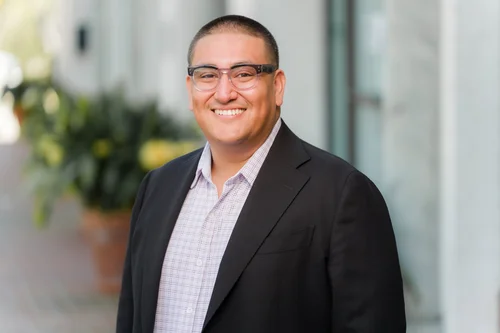
Fidel QuintanillaAMFT · Therapy for high achievers
Online therapist in California for high-achieving young adults — for anxiety, relationships, and the distance between looking fine and feeling fine.
Is this you?
Most of the people I work with are very good at their jobs.
Doctors. Attorneys. Engineers. People who can run a team, a case, a whole operating room — and then come home with no idea what to do with a feeling that won't resolve on a deadline.
Here's a thing I say a lot: let's get back to the basics.
Because the skills that make you successful — control, performance, output — are often the exact skills keeping you stuck everywhere else. You can't optimize your way out of a hard conversation. You can't sprint through grief.
I'm direct, and I work in the present. I'm less interested in excavating your childhood for ten years than in catching the pattern you're running right now — and asking what your values actually tell you to do about it.
We'll use real tools: pattern recognition, breath, committed action, saying the honest thing instead of managing everyone around it.
And yeah — sometimes we'll laugh. The work is serious. You don't have to be grim about it.
The goal isn't to perform a better life. It's to actually live in the one you've built.
What the work can feel like.
A lot of it is learning to pivot your thoughts instead of marinating in them. To get clear on what you actually value — and let that, not the pressure, set the direction.
It's the kind of work that tends to land in the body, too. It's common to leave a session carrying a little less than you walked in with — a bit more room in the chest, a bit less weight on the shoulders. Not because anything was forced, but because you finally felt safe enough to be honest about what's going on.
How I work.
I'm direct and practical. I work in the present — less interested in narrating the past for years than in the pattern you're running right now, and what your values tell you to do about it. You'll usually leave with something concrete to try before the next session.
I'm trained across CBT to interrupt the loops, EMDR for what's stored deeper than words, ACT for values and committed action, and EFT for the patterns that show up in relationships and dating. When things get overwhelming, we come back to the basics — breath, body, the next honest move. For why working in the present changes the brain over time, see Why Therapy Works.
What I help with.
The themes that come up most in my work — each links to more on how Align approaches it:
Who I work with.
High achievers in high-pressure careers — doctors, attorneys, executives, engineers — and modern daters trying to make sense of connection in their 20s and 30s. I also work with men who were never given much language for the inside of their lives, and with Latino/Latinx clients navigating culture, family, and expectation. I see culture as more than ethnicity: your age, how you were parented, gender, religion, sexual orientation, and financial reality all shape what you bring in. I offer individual and couples therapy.
Training & credentials.
- Associate Marriage and Family Therapist, California BBS #125756 — supervised by Jasmeet Bhullar, LMFT #117019
- Master's in Clinical Psychology, Pepperdine University
- Bachelor's in Psychology, California State University, Los Angeles
- Adjunct Faculty, Pepperdine University — teaches clinical psychology at the Master's level
- Former Director of the Transitional Living Program, Psychological Care and Healing Center
- Formal training in evidence-based methods including CBT, EMDR, and ACT
Logistics.
Sessions are held entirely online, on a secure platform, anywhere in California — from wherever you're comfortable. Availability is flexible: Sunday through Friday, mornings, afternoons, and evenings. The regular rate is $200 per individual session ($250 for couples), with a limited number of reduced-fee slots and out-of-network insurance reimbursement available. Start with a free 20-minute consultation — no commitment, just a chance to ask questions and see if we're a fit.
Questions about working with Fidel — answered.
How is therapy with Fidel different from therapy I've tried before?
I work in the present and keep things practical. Rather than narrating the past for years, I help you catch the pattern you're running now, name what your values point to, and leave each session with something concrete to try. A lot of my clients come to me after a more open-ended therapy, wanting a more direct and structured approach.
I'm skeptical about therapy — will it actually be useful?
That skepticism is welcome, and it's common among the high achievers I work with. I tend to set concrete goals early, explain the reasoning behind my approach, and pay attention to whether the work is moving. If something isn't helping, I'll say so and we'll adjust.
Can Fidel help with dating and relationship patterns, not just individual stress?
Yes. Alongside individual work, I use Emotionally Focused Therapy (EFT) for the patterns that show up in relationships and modern dating, and I see couples. Maybe the pattern you notice at work is the same one showing up with the people you date.
What does a first session with Fidel look like?
Mostly getting clear on what brought you in. You don't need to have it all figured out — bringing one specific pattern you want to work on is enough. I'll ask what you've tried and what you'd want to be different, and we'll start to map where to focus.
How will I know if therapy with Fidel is helping?
I pay attention to whether things are actually shifting — fewer nights stuck in the same loop, a hard conversation handled differently, a choice that lined up with your values. I won't promise a timeline, but you'll have a clear sense of what we're working toward and whether you're moving.