

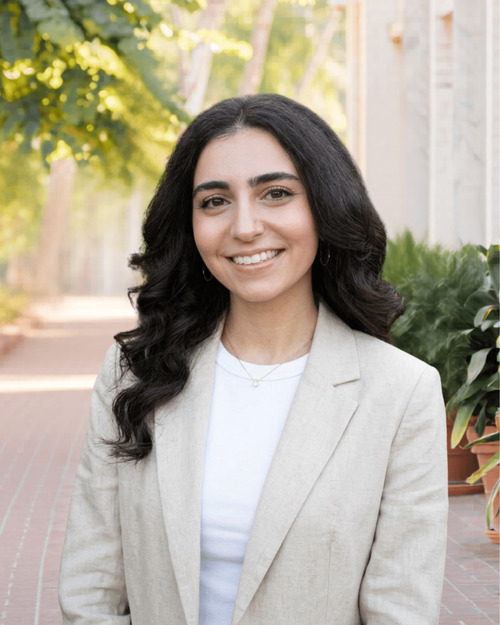
Michelle KaliliAMFT · Therapy for relationships & belonging
Online relationship therapist in California for young adults — for belonging, boundaries, and learning to say what you actually need.
Is this you?
A lot of the women I work with are very good at being who everyone else needs them to be.
The easy daughter. The low-maintenance partner. The friend who's always fine.
And it works — until it doesn't. Until "fine" starts to feel like a quiet kind of lonely, even in rooms full of people who love you.
I stay pretty literal in my work. I'm not going to hand you a metaphor about your inner garden. I'm going to ask you a plain question and then sit in the silence while you actually answer it.
Usually the question is some version of: is that what you want — or is that what someone else wants for you?
A lot of what we look at is where the pattern came from — the family you were raised in, the culture you carry, the relationship you just left. Not to blame any of it. Just to see it clearly.
And for clients from immigrant or complicated family backgrounds, part of the work is simple: here, you don't have to translate yourself.
Most of the time you already know what you want to do. You're just not ready to take the step yet — and that's where we start.
What the work can feel like.
A lot of it is slower than people expect. I'll ask a plain question — often some version of, is that really what you want, or is that what someone else wants for you — and then I'll let the silence sit while you find the honest answer. Most people aren't used to being given that much room.
We tend to look at where a pattern came from without turning it into blame: the family you were raised in, the culture you carry, the relationship you just left. For clients from immigrant or traditional families, part of the relief is not having to translate any of it first — it's already allowed in the room.
And often the work isn't about discovering what you want. You usually know. It's about the gap between knowing and being ready to take the step, and we move at the pace that gap actually needs — with a little warmth, and the occasional bit of humor when it lands.
You don't have to keep being fine. You're allowed to be known instead.
How I work.
My style is warm, grounded, and unhurried. I stay literal — I reflect back what I actually hear, I'm comfortable letting a silence sit until something true surfaces, and I'm not afraid of a little humor when it lands. Therapy with me is a place you can say the real thing without bracing for judgment.
I draw on attachment work to understand the patterns you learned early about closeness and need, cognitive and solution-focused tools for what's in front of you now, and mindfulness to help you stay with a feeling instead of rushing past it. We keep an eye on the cultural and family influences shaping how you act today. For more on why the relationship itself is what heals, see Why Therapy Works.
What I help with.
The themes that come up most in my work — each links to more on how Align approaches it:
Who I work with.
Women in their 20s and 30s working on relationships, belonging, and complicated family and cultural patterns — including clients from immigrant or traditional backgrounds who are tired of having to translate themselves to be understood. I see culture as more than ethnicity: your age, whether you're a parent, gender, religion, sexual orientation, and financial reality all shape what you bring in. I offer individual, couples, and family therapy.
Training & credentials.
- Associate Marriage and Family Therapist, California BBS #157551 — supervised by Jasmeet Bhullar, LMFT #117019
- Master's in Clinical Psychology, Pepperdine University
- Bachelor's in Psychology, Loyola Marymount University
- Clinical experience as a Therapist at Counseling Partners of LA
- Training across multiple organizations in attachment-based and evidence-based methods
Logistics.
Sessions are held entirely online, on a secure platform, anywhere in California. Availability is flexible: Sunday through Friday, mornings, afternoons, and evenings. The regular rate is $200 per individual session ($250 for couples and families), with a limited number of reduced-fee slots and out-of-network insurance reimbursement available. Start with a free 20-minute consultation — no commitment, just a chance to ask your questions and see how it feels.
Questions about working with Michelle — answered.
What makes Michelle a good fit for clients from immigrant or traditional families?
I keep the cultural and family context in view rather than treating it as something to discard. For clients from immigrant or traditional backgrounds, part of the relief is simply not having to translate yourself to be understood — the loyalty, the expectations, and the in-between are all allowed in the room.
I've never done therapy — what does a first session with Michelle look like?
Mostly a conversation about what brought you in, a little of your background, and what you're hoping to work on. I'm not trying to fix you in the first hour; I'm trying to understand you. You can also tell me what you don't want to talk about yet — naming that often builds trust faster than performing openness.
Does Michelle work with couples and families, or only individuals?
Both. I offer individual, couples, and family therapy, which helps when the pattern you're working on lives inside a relationship rather than only inside you.
How is Michelle's style different from other therapists?
I stay literal rather than leaning on metaphor, I reflect back what I actually hear, and I'm comfortable letting a silence sit until something true surfaces. Warm and grounded, with a little humor when it lands — and a gentle challenge when you're circling something you already know.
How will I know if therapy with Michelle is helping?
Sometimes it's a hard conversation you finally have, or a need you voice without apologizing for it. I won't promise a timeline — some months feel quiet, and then a decision lands cleanly and you realize the work was happening all along.