

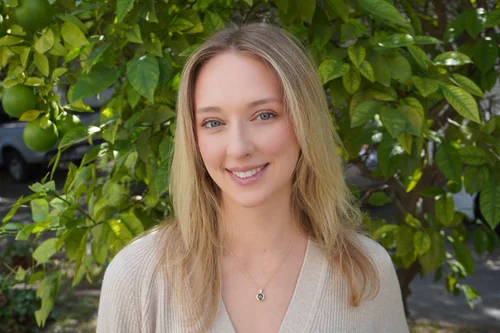
Marjolaine BernsteinAMFT · Therapy for anxiety, OCD, relationships & intimacy
Online therapist in California for adults navigating anxiety, OCD, relationships, and sexual intimacy, with particular care for women.
Is this you?
Many of the people I work with have been doing well on paper for a long time.
They've been competent, careful, reliable. They've learned to anticipate what might go wrong, to catch problems early, to adapt around other people's needs. From the outside, that often looks like high-functioning.
From the inside, it can feel like a quiet exhaustion that doesn't have a name yet.
Sometimes that's anxiety that has learned to look like competence. Sometimes it's OCD: a mind that returns to a worry long after everyone else has moved on, and keeps needing to be sure. And sometimes it shows up in intimacy, where desire has shifted or the body isn't responding the way someone expected, and the shame about it has grown louder than the thing itself.
Part of the work is getting curious about what's underneath. Maybe a nervous system that learned early to scan for problems. Maybe a hormonal or physical change nobody has named yet. Maybe a yes that gets replayed hours later.
Whatever it is, there's usually more to understand than this is just how I am.
You don't have to keep holding everything together on your own.
What the work can feel like.
Working with me tends to be collaborative, careful, and willing to sit with complexity before trying to resolve it. Many people come in frustrated with themselves, believing they should be able to out-think the anxiety, out-plan the worry, or will themselves into feeling differently. Part of the work is slowing that down. There's often good information in what the worry is trying to protect, in what the body is trying to communicate, in what the yes was helping maintain.
For some of the people I see, especially those navigating OCD or OCD-adjacent patterns, the work includes Exposure and Response Prevention (ERP) when it fits. I work with it carefully, at a pace the person can tolerate. Not every piece of OCD work looks like formal ERP. Sometimes a person needs groundwork around understanding their own responses before any kind of exposure feels possible.
For individuals and couples navigating differences in desire, arousal, or closeness, I try to bring real curiosity, the kind that doesn't rush to make one person the problem. Mismatched desire is one of the most common and least-talked-about experiences in long-term relationships. Sometimes what makes it hard isn't the desire itself. It's the shame and silence that have built up around it.
Change is rarely linear. Sometimes the work is less about doing more and more about letting what's underneath finally have room.
How I work.
My approach draws from Exposure and Response Prevention (ERP) for OCD, Cognitive Behavioral Therapy (CBT) and mindfulness-based practices for anxiety, and an attachment lens for relationships. For sexual and intimacy concerns, I bring sex-therapy training as an AASECT member, along with a lot of psychoeducation, because understanding what the body and nervous system are doing is often the first thing that loosens the shame. I draw on different approaches depending on what the person in front of me needs. For more on why this kind of work changes things over time, see Why Therapy Works.
What I help with.
The themes that come up most in my work — each links to more on how Align approaches it:
Who I work with.
Adults across California, with particular care for women navigating anxiety, OCD, perfectionism, and the invisible labor of chronic over-functioning. Individual and couples therapy. The intimacy and sex-therapy work I do spans different relationship structures, orientations, and life stages, and it always starts with understanding the room two people are standing in before offering anything prescriptive.
Training & credentials.
- Associate Marriage and Family Therapist, California BBS #164685 — supervised by Jasmeet Bhullar, LMFT #117019
- Member, International OCD Foundation (IOCDF) — one of four IOCDF members on Align's clinical team
- Member, AASECT (American Association of Sexuality Educators, Counselors and Therapists) — working toward the AASECT Certified Sex Therapist credential
- Master's in Clinical Psychology with an emphasis in Marriage and Family Therapy, Pepperdine University — the shared graduate program of every Align clinician. Presented research at the Pepperdine GSEP Annual Research Symposium (Switzerland).
- BA Sociology, minor in Applied Psychology, UC Santa Barbara — previously a Research Assistant at UCSB
- Author, “It's Not You or Your Partner — How Hormones Can Spark a Sex Shame Spiral” (Pituitary World News)
- Previously MFT Trainee, Free Clinic of Simi Valley — adults: anxiety, trauma, relationships, life transitions, and couples therapy
Logistics.
Sessions are held entirely online, on a secure platform, anywhere in California. Availability is flexible: Sunday through Saturday, mornings, afternoons, and evenings. The regular rate is $200 per individual session and $250 per couples session, with a limited number of reduced-fee slots and out-of-network reimbursement available. Start with a free 15-minute consultation.
Questions about working with Marjolaine, answered.
Who does Marjolaine work best with?
Adults in California navigating anxiety, OCD, relationship difficulties, or changes in sexual intimacy, with particular care for women. Many of the people I work with have been doing well on paper for a long time (competent, careful, reliable) and have gotten used to a kind of low-grade strain they're not sure what to call.
Does Marjolaine specialize in OCD?
Yes. OCD is a core part of my work, and I'm a member of the International OCD Foundation (IOCDF). I use Exposure and Response Prevention (ERP), the evidence-based treatment for OCD, when it fits, at a pace the person can tolerate.
OCD often shows up in forms people don't expect: Pure O, intrusive thoughts, mental checking, relationship OCD, scrupulosity. Sometimes the first part of the work is simply understanding what's happening before any kind of exposure feels possible.
Does Marjolaine offer sex therapy?
Yes. Sex therapy is one of my specialty areas. I'm a member of AASECT, the American Association of Sexuality Educators, Counselors and Therapists, and I'm working toward the AASECT Certified Sex Therapist credential.
People come in with changes in arousal or desire, performance pressure, questions about satisfaction, or mismatched desire between partners. I work with individuals and couples, and with real care around the shame that so often makes these conversations hard to start.
What's Marjolaine's therapy style?
Collaborative, careful, and willing to sit with complexity before trying to resolve it. I tend to get curious about what a worry might be protecting, what the body might be communicating, and what a pattern has been helping someone hold together, before trying to change anything directly.
Sometimes the work moves into structured practice, like ERP for OCD. Sometimes it stays slower and more exploratory. Often it's some of both.
What does a first session with Marjolaine look like?
Mostly understanding what brought you in and what you're hoping for. There's no pressure to explain yourself cleanly. We move at a pace that lets you open up, and I spend a lot of first sessions listening for what sits underneath the version of the story someone has rehearsed.
How will I know if therapy with Marjolaine is helping?
For many people, the first sign is that something that used to feel stuck begins to have a little more space around it. A worry that kept returning. A yes that kept being automatic. A pattern that kept repeating in a relationship. Not necessarily gone. Just less loud.
Progress often looks like noticing yourself in moments where you used to be on autopilot, and having more choice in how you respond.